The Case for Interim Zoning
by Jim Webster
Many Bozeman residents have been asking that the building height allowed in the B-3 zoning district downtown be reverted to 70 feet from the 90 feet granted in the Unified Development Code (UDC) update that went into effect February 1. Several public comments have been submitted, along with a petition that contains over 300 signatures in support of the return to 70 feet (you can add your name here). Some argue the return to 70 feet is to protect the viewshed of our several surrounding mountain ranges for the enjoyment of all downtown. Others argue for the preservation of the character of our historic downtown, which itself will be harmed by taller buildings built in a halo around it. While still others beg us not to give away the extra development potential without extracting some public good, like cash-in-lieu of affordable housing, or talk about parking issues and the potential for increased congestion, as the streets are not getting any bigger. All of these are valid arguments from my perspective.
To understand the source of residents’ opposition to taller buildings downtown, and to entertain ways to address this broad concern, the realization has hit me:
What many may be opposed to is not necessarily tall buildings themselves (though that is a possibility) but poor design incompatible with our historic downtown character.
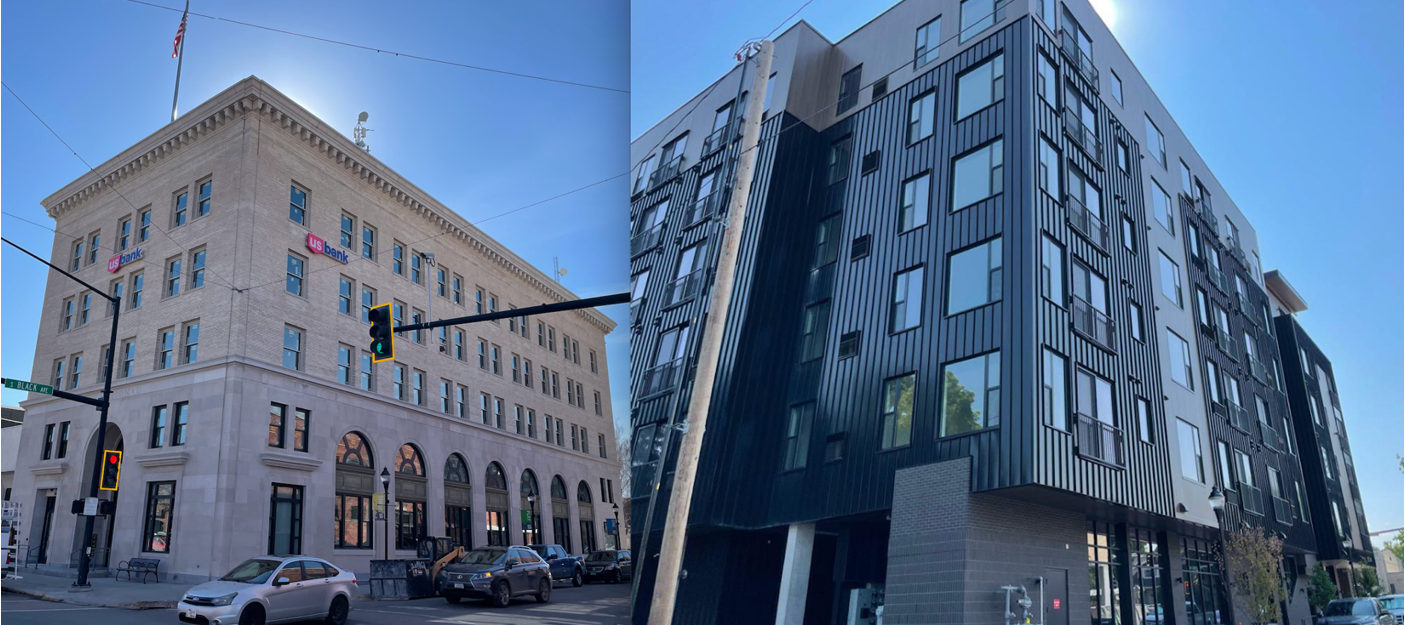
The recently renovated US Bank building downtown (left) has garnered adoration from many, while other recent construction (right) has elicited letters to the editor in which the author asks the city to stop allowing “turds on the landscape” saying, “If you're going to overbuild Bozeman, at least make it look good.”
This combination of tall AND less attractive, indisputably has the potential to destroy the character of our historic downtown, which after all, is the largest economic driver of tourist dollars.
The historic character of our downtown is a leading contributor to the vitality of the district. It can also be argued that our historic downtown is one of the things that differentiates us from other surrounding cities, leading people to choose to relocate to Bozeman.
-BEAUTY AND THE BEAST-
Some will say, beauty is in the eye of the beholder, suggesting we should not regulate design. Who’s to say what’s beautiful? In truth, there is more agreement about what is considered to be a beautiful building than you might think! This quick 13 minute video created by a group of Dutch professionals, references several statistically valid studies, conducted all around the world, that inform us about what most people find beautiful or preferable.
Spoiler alert: people prefer traditional architecture above modernist architecture…
by a huge margin!
In 1991, the City of Bozeman created the Neighborhood Conservation Overlay District (NCOD) “to stimulate the restoration and rehabilitation of structures, and all other elements contributing to the character and fabric of established residential neighborhoods and commercial or industrial areas. New construction will be invited and encouraged provided primary emphasis is given to the preservation of existing buildings and further provided the design of such new space enhances and contributes to the aesthetic character and function of the property and the surrounding neighborhood or area.”
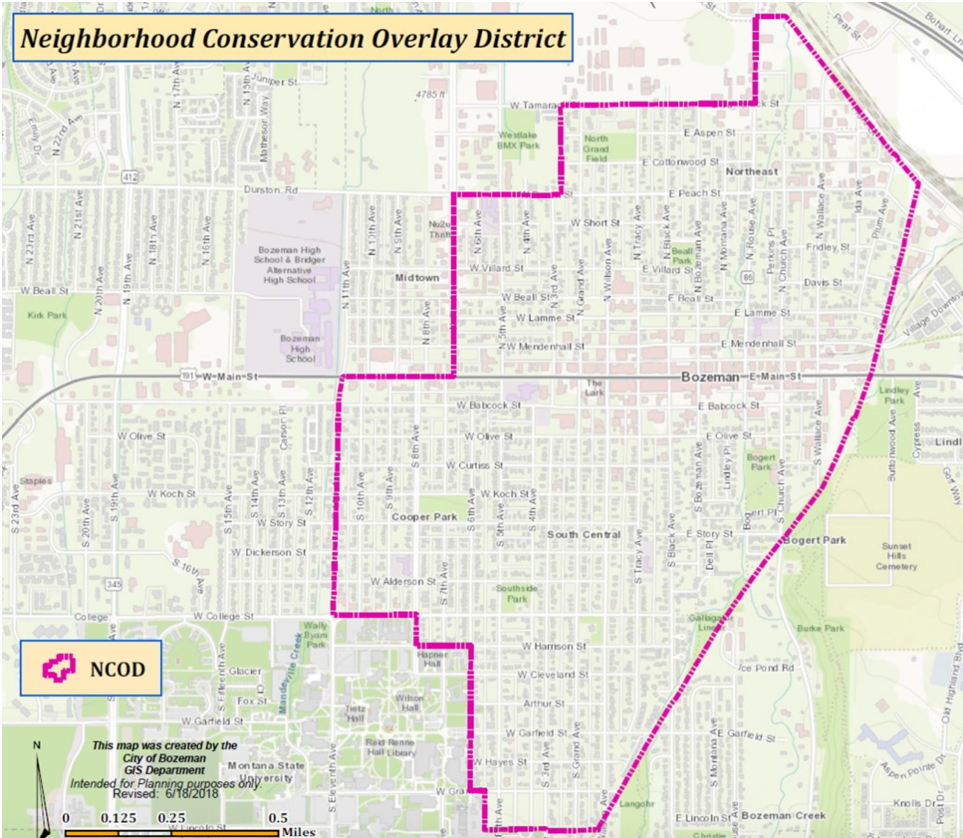
This district was very forward thinking for its time, and outside consultants are continually impressed with it. Guidelines were written to regulate the design of development within the district.
Bozeman made a commitment to future generations when designating and regulating the Conservation District.
This is why we have such desirable neighborhoods, and a historic downtown, that together provide a tangible link with our past. Ask anyone and they will probably tell you it’s also the most beautiful part of the city, but it is being marred by newer, more modernist, tall buildings.
The Bendon Adams (BA) report, submitted to the city in 2019, (the link to that report is here and makes for outstanding reading) lays the groundwork for the Lakota Group consultants that are coming to Bozeman in April to update the NCOD guidelines in partnership with the city’s Community Development Department. BA did much engagement with our community and the hope is that Lakota will as well. Several of us have leaned hard on the city to support the Historic Preservation Advisory Board (HPAB) and the community to have a stake in the process. Public Comments over the next 2-4 weeks will go a long way to help reinforce this initiative.
Thus, due in large part to public participation asking for the Design Guidelines for the NCOD to be enforced to a greater degree, the city has hired these consultants to update these design guidelines. The city is also currently engaged with consultants to create a Local Landmark Program and rework Historic Preservation standards generally to cover the entire city, not just the NCOD. This section of code was not addressed over the last several years as part of the Development Code update, but it has been carved out separately and the work is ongoing.
-A MATTER OF SOME URGENCY-
While this work is ongoing, it is prudent to consider enacting an interim zoning ordinance to prevent “uses that may conflict with a zoning proposal that the governing body is considering or studying.” Its goal would be to prevent more soviet-style “boxy” structures from sneaking in before we have design guidelines updated. Interim Zoning is allowed to us by the most recent edition of Montana Code Annotated title 76, chapter 25, item 307.
76-25-307. Interim zoning ordinances. (1) A local government, to protect the public safety, health, and welfare and without following the procedures otherwise required prior to adopting a zoning regulation, may adopt an interim zoning ordinance as an urgency measure to regulate or prohibit uses that may conflict with a zoning proposal that the governing body is considering or studying or intends to study within a reasonable time. (emphasis added)
The public participation during the update to the NCOD Design Guidelines will inform the conversation on height in our historic downtown. Public input may mean we revert to a 60 feet height limit (the minimum required by state law). The resulting updated guidelines themselves will inform the design of new construction to make sure it is aligned with community values. New preservation code generally will regulate demolition and guide development across our city, not just within our historic core. These are the zoning regulations that the Commission is considering that would justify interim zoning.
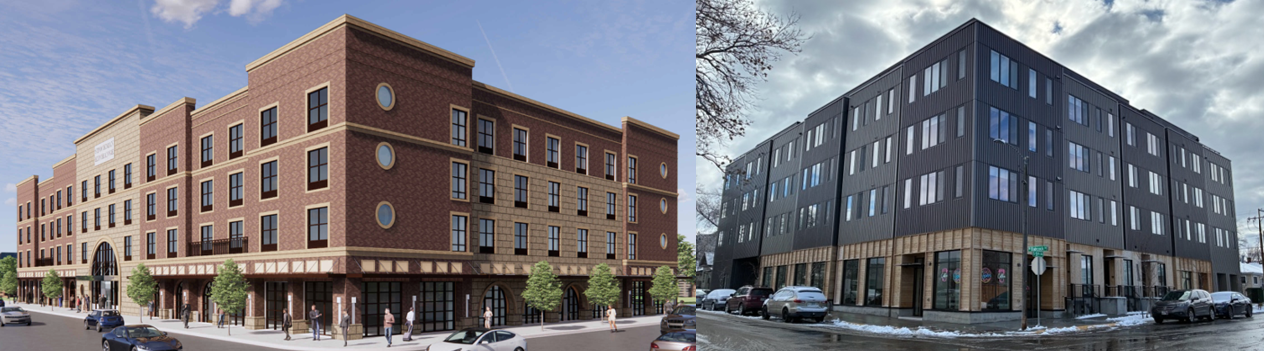
These two buildings above are both new buildings in Bozeman. The hotel at 5th and Main is being constructed right now (left). The West Babcock apartments (right) was finished recently. These buildings are both in zoning district B-2M, AND in the NCOD! But which design do you think beautiful? Which design better respects the historic nature of our core neighborhoods and commercial districts?
This is the difference design guidelines CAN make.
Relatively simple changes to proportions, colors, the amount of detail, symmetry, materials used, and façade articulation can make a larger building more palatable, so it is not a question that all large buildings are bad.
The Montana code alludes to interim zoning being an “urgency measure.” As of March 13th 2026, Bozeman will not have a Historic Preservation Officer (HPO). The HPO is tasked with coordinating the City’s Historic Preservation Program and is required by our municipal code to satisfy the Secretary of the Interior’s Professional Qualification Standards. Who will guide this important work of rewriting our historic preservation program, implementing a Local Landmark program, and updating the NCOD design guidelines, if we have no HPO!? The answer is that it will be left to our Director of Community Development and Deputy Director of Community Development to carry this out, and while they are well-intentioned, to my knowledge, they don’t have that extra background in historic preservation planning.
I believe this constitutes a matter of some urgency, that justifies the use of interim zoning to pause demolitions and applications for new large developments within the NCOD, until a new HPO is hired AND these important land use regulations are completed. The pause would not affect any projects already in the pipeline.
-BUT WHAT ABOUT THE HOUSING CRISIS?-
Many people say we shouldn’t put any restraints on growth because we have a housing crisis. Therefore, we can’t possibly temporarily pause development (through the use of an interim zoning ordinance) while we rewrite the design guidelines for the Conservation District. These same people tell us design regulations just make things more expensive.
In reality, we do not have a housing supply crisis, we have a housing affordability crisis, as explained by McClure and Schwartz. The latest Bozeman Economic & Market Update report states that we have a huge surplus of multifamily housing! In fact, the average multifamily market-wide vacancy rate went up from 12.6% in 2024 to 18.7% in 2025. The vacancy rate for the approximately 1,900 units built in 2024 and 2025 was 44.2% (pp 41-42).
The high vacancy rate in new construction alone is enough to refute arguments that restraining growth at this time will result in insufficient housing supply.
We have plenty of supply!
As for making projects more expensive, the façade of a building is not a large determinant of cost. Depending on the style of construction (wood framing vs. steel) and the overall scale of the building, façade materials might account for 2-5% of the project cost. A much larger influence on project cost is the other 3 L’s. The 4 L’s include Land, Labor, Lumber, and Lending, with lumber being materials including façade treatments. The other 3 L’s are not affected by the design of the building. In this reality, affordability will not be achieved without subsidy, especially in the NCOD where land costs are the highest.
The fact that the new construction will also not be affordable or accessible to our workforce is another reason temporarily pausing new large multi-family construction in the NCOD will not result in insufficient supply of housing.
Additionally, the city is also forced in the near future to look at its Affordable Housing Ordinance (AHO) due to the state removing Bozeman’s ability to use the most effective incentives originally included. The congestion and parking issues in the downtown core have been a major community concern for some time. An interim zoning ordinance could give the Downtown Urban Renewal District and the Downtown Business Improvement District time to decide how to handle these problems of increased parking demand and congestion before adding more high-density projects.
I would argue this is the perfect time to take a breath and get our house in order!
-THE BEST WAY FORWARD-
Therefore, I propose that the Bozeman City Commission consider enacting an interim zoning ordinance that TEMPORARILY prohibits demolition and new applications for new developments over 30,000 sq. feet within the NCOD until a Historic Preservation Officer who meets the Secretary of the Interior’s Professional Qualifications is hired, and the new Historic Preservation code, Local Landmark Program, and updated design guidelines for the NCOD are adopted. This could take up to one year.
This interim zoning ordinance would be TEMPORARY, and would not apply to any development applications outside of the NCOD. It would NOT apply to structures declared unsafe. It would NOT apply to single family homes, restorations, renovations, or applications for Additional Dwelling Units (ADUs). It would NOT apply to applications that have already gained adequacy. If they are in the pipeline, they proceed under existing regulations.
This pause will allow for the entire community to use and observe the new February 1 Unified Development Code in action, outside of the NCOD, while safeguarding our historic resources and conservation district, until we replace our Historic Preservation Officer and put in place our various new and updated Historic Preservation policies.
Many residents are asking for development of these large structures to be paused outside the Conservation District. Unfortunately, there isn’t a legal pathway to do so. Remember, a municipal government can only enact interim zoning if they are considering a land use regulation with which projects would conflict. The Unified Development Code has been recently adopted, and there was robust public participation. Therefore, only areas subject to the regulations the city is investigating or considering (historic preservation code and design guidelines) are eligible for an interim zoning ordinance.
Another factor that suggests interim zoning is a responsible action to take is that it will result in a reduction in staff workload.
This will have benefits beyond allowing staff to successfully hire a new HPO and execute the Local Landmark Program, Historic Preservation code generally, and the NCOD Design Guidelines.
The newly begun replacement of the City’s Enterprise Resource Planning (ERP) software will affect staff time and budget across every department in the city. Removing applications for large projects within the NCOD (which necessitates a higher amount of staff time to evaluate additional review requirements) while there is no Historic Preservation Officer to do that work, will reduce staff workload across multiple departments temporarily. This will allow staff to focus on the smooth evaluation of their work flows and eventual configuration of a new ERP system.
The current City Commission has also put forth as a priority, streamlining the development review process. Reducing staff workload temporarily will allow for more dedicated attention to this priority. This will ensure that once the interim zoning ordinance expires, we will be better placed to pursue our strategic plan goals 4.2: High Quality Urban Approach, and 7: High Performance Organization.
-PUBLIC SUPPORT FOR A PAUSE-
Recently, several hundred residents both from inside and outside of the NCOD, participated in a basic survey organized by the Inter-Neighborhood Council (INC), and administered by the city to gauge interest in enacting an Interim Zoning Ordinance (IZO). The highlights were that 428 residents turned a survey in with 83% supporting that the city should pause approval of the development of large projects for one year and 84% supporting that INC recommend that the city hold a public hearing to enact an Interim Zoning Ordinance. This survey was done just to check the pulse of the community and we knew that we might get less supportive responses from those outside the NCOD. That did not happen as the lowest support level for an IZO from a non-NCOD neighborhood clocked in at 68%. Results from the 14 neighborhoods surveyed can be found here.
In closing, the Bozeman Hotel Owners Association (BHOA) submitted a well-written piece on December 15, 2025 speaking to some of the negative attributes of permitting the B3 90 feet height allowance. That document can be found here. Thank you readers for your interest in this topic.